 ™
Whitepaper — 2026
™
Whitepaper — 2026
The Preconstruction Gap™ Framework
The
Preconstruction
Gap™
How Every Construction Project Fails Before It Begins
And What the Firms That Do Not Fail Are Doing Differently
™
Whitepaper — 2026
The Preconstruction Gap™ Framework
How Every Construction Project Fails Before It Begins
And What the Firms That Do Not Fail Are Doing Differently
Executive Summary
That is not a provocative claim. It is a structural observation drawn from fifteen years of working directly inside the preconstruction problem. The decisions that determine project outcomes are made in the earliest phases of delivery. The decisions left unmade carry the same weight. By the time a coordination meeting surfaces a conflict, the project has already lost.
This paper defines the Preconstruction Gap™: the space between what a project requires to succeed and what is actually produced before construction begins. It examines how the gap forms, why it persists, and what the firms closing it are doing differently.
The framework presented here is the product of original research and direct observation. It is the basis for a full-length book arriving in September 2026.
01 / The Structural Problem
Construction demand is rising across every major sector. Data centers, semiconductor manufacturing, energy infrastructure, healthcare, advanced manufacturing. Projects are scaling in complexity and compressing in schedule simultaneously. The industry is being asked to do more, faster, with the same fundamental workflow it has used for decades.
The symptoms are well documented. Coordination conflicts discovered late. Rework that consumes budget and schedule. Estimating that produces a winning bid and a losing project. Firms declining work not because the opportunity was wrong, but because they lacked the capacity to pursue it responsibly.
The diagnosis is almost always wrong. The industry concludes it has a coordination problem, a staffing problem, or a technology problem, and applies solutions at those levels. The symptoms improve slightly. The root cause goes untouched.
The root cause is timing. The work that determines project outcomes is happening too late.
Three structural constraints converge to create the conditions for this failure:
When these three constraints operate simultaneously, a gap opens between what the project requires and what the preconstruction team can realistically produce within the schedule. This is the Preconstruction Gap™. It is not a symptom of poor project management. It is a structural condition.
02 / How the Gap Forms
Most projects do not fail randomly. They fail in a pattern. Understanding the mechanics of that pattern is the first step toward breaking it.
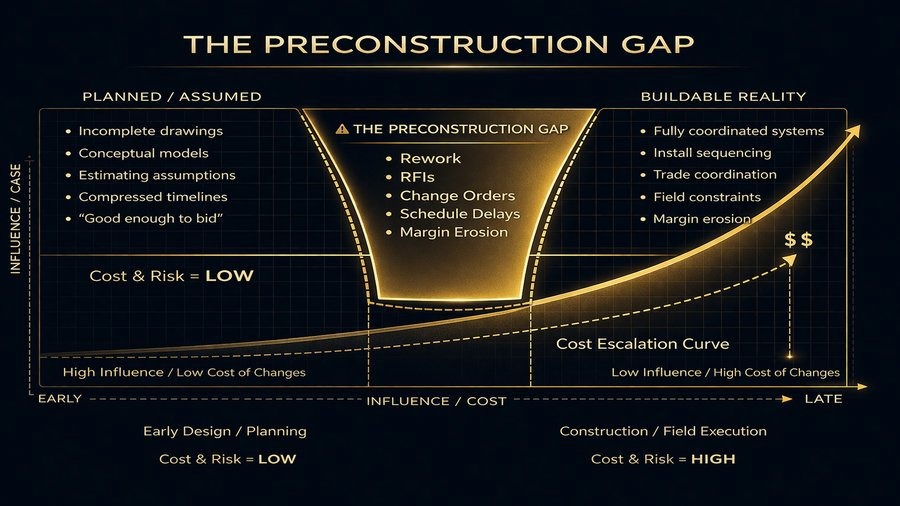
Figure 1 — The Preconstruction Gap™ | Andrew Fortinberry | 2026
Preconstruction Compression
Teams must produce takeoffs, conceptual models, and bid packages quickly to remain competitive. Models are accepted before they are fully developed. Incomplete design information is carried forward. The gap opens here.
Coordination Begins Under Pressure
The project enters coordination carrying the unresolved issues from preconstruction. Missing design data, spatial conflicts, inconsistent modeling standards, and incomplete trade coordination all surface simultaneously. The team is already behind.
Discovery Becomes Redesign
Instead of validating the design, coordination becomes an extended redesign process. The team is no longer coordinating. They are solving problems that should have been resolved upstream. Budget and schedule absorb the cost.
The Reactive Cycle
The project enters a reactive loop: clash, redesign, recoordination, schedule pressure, field adjustment. This cycle consumes significant time, budget, and organizational energy. Teams become skilled at managing the chaos rather than preventing it.
Root Cause Is Missed
Because the symptoms appear during coordination, the coordination process is blamed. Improvements are applied at the wrong stage. The structural root cause — work happening too late — goes unaddressed. The next project begins the same way.
The coordination issues most projects experience were rarely created during coordination itself. They were embedded months earlier, during the phases where teams were moving fastest and investing least in documentation quality. Coordination does not create the problem. It inherits it.
Andrew Fortinberry03 / Root Cause
The fundamental issue is not software. It is not staffing levels. It is workflow timing.
Most firms treat modeling and detailing as activities that occur after the project is awarded. The production team engages when there is a contract to reference. The logic seems sound. Why invest in detailed production work before the project is confirmed?
The answer is cost compounding. The most impactful coordination decisions occur during conceptual modeling, estimating support, bid package development, and early system layout. When these phases are under-resourced, the downstream consequences compound exponentially.
"Are we asking coordination to solve problems that should have been designed out during preconstruction?" For most project teams, the honest answer is yes.
Figure 2 — Cost Escalation Curve | Andrew Fortinberry | 2026
The Construction Industry Institute has documented that fixing a design error during preconstruction costs roughly one-tenth of what that same fix costs once work reaches the field. Upstream investment does not increase project cost. It redirects cost that would otherwise be spent on reactive rework at ten times the price.
The firms closing the Preconstruction Gap™ are moving technical production earlier into preconstruction. Not by adding permanent headcount. By restructuring where the work happens in the project timeline.
04 / The Solution
Closing the Preconstruction Gap™ does not require a technology platform or a process overhaul. It requires a decision about when work happens.
The firms restructuring delivery around this principle share four operating characteristics. These are direct observations from firms that have measurably reduced coordination conflicts, shortened preconstruction cycles, and increased bid competitiveness by addressing the gap at its source.
Production Lanes
Tasks requiring high-speed digital production are explicitly separated from tasks requiring on-site decision-making, trade judgment, or client engagement. Internal teams focus on coordination and strategy. Production runs in parallel without competing for the same bandwidth.
Standards Documentation
Clear LOD standards, file structures, layer conventions, and modeling workflows ensure all contributors work consistently. The investment in standards documentation pays back immediately in reduced QC cycles and faster onboarding of production capacity.
Embedded QA/QC
Structured review cycles are built into the workflow at defined production milestones, not applied as a final check before submission. Quality assurance is distributed across the process rather than concentrated at the handoff.
Structured Communication
Regular alignment between project teams and production contributors ensures continuous workflow integration. Decisions are logged, scope changes are tracked, and production never operates on outdated information.
When these four principles operate together, the result is measurable: shorter preconstruction cycles, higher-quality coordination model entry points, and fewer field conflicts attributed to documentation errors.
05 / Self-Assessment
If any of the following statements are true for your firm, you are carrying Preconstruction Gap™ risk into every project you deliver.
Two or more of these? The gap is structural, not situational. The good news: it is solvable. The firms that address it gain a durable competitive advantage in bid competitiveness, coordination quality, and schedule predictability.
06 / The Future of AEC Delivery
The AEC industry is entering a new phase. Demand for complex infrastructure continues to rise. Projects are accelerating. Digital coordination is becoming essential rather than optional. The firms that succeed in this environment will not simply adopt new technology. They will redesign how work flows through their organizations.
The next generation of industry leaders will operate with hybrid delivery architectures that combine local expertise, embedded digital engineering capacity, and scalable production support into a single, integrated workflow.
Local Expertise
Strategic decisions, client relationships, trade coordination, and on-site judgment. The irreplaceable human layer.
Digital Production
BIM production, documentation, modeling, and detailing scaled to project demand without fixed overhead growth.
Global Capacity
Standards-compliant production running in parallel with project development, not after it.
The complete argument for why this shift is inevitable, what it looks like in practice, and how firms can position themselves to lead it is the subject of The Preconstruction Gap™: How Every Construction Project Fails Before It Begins, by Andrew Fortinberry. Releasing September 2026.
Ready to Close the Gap?
The complete argument arrives in book form in September 2026.
preconstructiongap.com
andrew@preconstructiongap.com
About the Author

Andrew Fortinberry
Originator, Preconstruction Gap™ Framework
Client Services Director Incorporated
Andrew Fortinberry is a construction industry strategist and the originator of the Preconstruction Gap™ framework. With over fifteen years of experience in technology sales across AEC, manufacturing, and product design, he has spent his career at the intersection of preconstruction strategy, digital delivery, and operational performance.
He works directly with general contractors, preconstruction leaders, and VDC decision-makers across the United States and Southeast Asia, helping firms win work they would otherwise be forced to turn down. He is currently Client Services Director at a US-managed BIM and VDC delivery firm headquartered in Decatur, Georgia.
Andrew will speak on the Preconstruction Gap™ at the ASPE East Region Virtual Summit on June 5, 2026. His first book, The Preconstruction Gap™: How Every Construction Project Fails Before It Begins, is scheduled for release in September 2026.
Everything Andrew builds is for his son, Leonardo.
™